Once upon a time, a very long time ago, in the early 1700s, a European woman made preparations to emigrate to the New World. She packed her belongings, among which was a small chest. Inside the chest was an even smaller cloth-wrapped parcel that contained invaluable cargo: the seeds from every medicinal herb in her garden. Precious medicine that would hopefully survive the arduous journey and serve them well in their new home. Mugwort, mullein, feverfew, borage, chamomile, rosemary, foxglove, and more. Like the humans that carried them, the seeds were strangers in a strange land.
Like humans, plant people flourished in the New World, gaining a foothold. Also, like humans, some plant people can be greatly beneficial, others radically destructive.
I once had a friend who was a certified native plant master. She was passionate about native plants, promoted them, and educated the community on them by conducting regular “native plant walks.”
She taught me a tremendous amount about native plants, and I credit her with my deep love of plant lore and magic.
This friend would speak out passionately against invasive, non-native species and encourage people to yank them out if they could identify them. She believed non-natives had no place in the ecosystem.
In my opinion, her first mistake was conflating “non-native” with “invasive.” There is a difference. To be classified as invasive, the plant must pose a risk of harm to the ecosystem. Non-native species do not pose a risk of harm, are benign, or may even benefit the ecosystem. A plant with an invasive designation in one ecosystem may be designated as non-native in another.
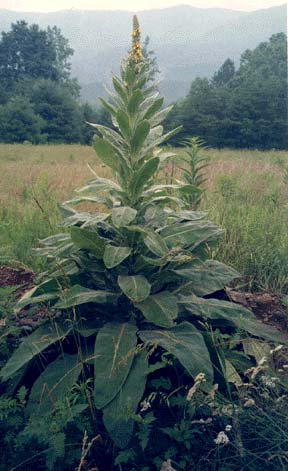
Mullein is the perfect example. This plant has a long history of use as medicine, both by the Europeans who introduced it and by Native Americans who recognized its medicinal properties. In New Mexico, where I live, mullein is called Bįįhyiljáa’í by the Diné people. It is found at low and mid elevations, growing in dry soil and on roadsides. Ours is an arid climate, and that helps control mullein to some degree. It is not classified as a noxious weed, and it’s not of great concern. However, it is listed as a serious environmental threat in states such as Oklahoma and Colorado.
Why? Because the conditions in these places allow Mullein to grow unchecked. It grows so fast that it outcompetes the native plants. Why is this a problem? Because it disrupts the ecosystem. There are native fauna that evolved alongside the native flora, and some of them rely on those plants as their sole food source. Mullein is not a preferred food source for deer or other mammals; few birds eat the seeds, and while honey bees are attracted to mullein, most native bees and wasps are not. Domestic livestock won’t eat it. Mullein is a prolific reproducer that can quickly crowd out all other food sources in an area and become a real problem.
Is that mullein’s fault? No. Mullein is doing what mullein does.
Which leads me to her second mistake. Although she claims to be an animist, she doesn’t see non-native plants as people.
In his book Right Story, Wrong Story: How to Have Fearless Conversations in Hell, Tyson Yunkaporta discusses the “wrong story” of invasive species. The dominant culture labels introduced species as invaders, blaming them for the collapse of ecosystems while simultaneously ignoring the imperialist systems and human colonizers who trafficked them in the first place.
Colonization is driven by the concept of divine ordination and entitlement, e.g., Manifest Destiny. With this as the motivation driving human behavior, the goal becomes conquest and exploitation. The land is seen as a lifeless commodity and its indigenous people, human and not, as something to be eradicated in the name of “progress.” There is a complete relational disconnect, no reciprocal relationship with other living things, no custodianship of the land, and so the imported species behave just as the humans who brought them. They come in and take over to the detriment of the native inhabitants. If you, like me, are of colonial/settler descent, the real responsibility for invasive species-driven ecological collapse lies squarely on our doorstep.
So what’s to be done? Well, for starters, those of us making claims to practicing “earth-based” religions need to focus on the earth beneath our feet. Praxis in situ. Get to know the land you live on; educate yourself about both its spiritual and physical characteristics. Begin building a respectful relationship with the people around you, both human and nonhuman. Let the moral values of your chosen path guide your right relationship and practical action with the area you currently inhabit, whether it be the middle of an urban center, a suburban community, or a remote rural area.
Yunkaporta says that we should work to naturalize the unfamiliar; cross-cultural and ecological healing can come from long-term cultural practice. Attempted eradication on both fronts is useless. Imported species can become part of a resilient ecosystem with human help, stewardship, and reciprocity.
Humans are part of the ecosystem, not separate from or above it. Yunkaporta calls us a “custodial” species. The traditional practices and knowledges of indigenous people demonstrate this concept. When you begin to connect with and give back to the land through care, ritual, respect, and mindfulness of what you take from it you begin building a restorative kinship that will allow you to inhabit your environment in a non-destructive way. It will foster deeper consideration and respect for all living things and help you connect meaningfully with your community.
This brings us back to mullein. Mullein is my relative; my people brought her here, and she is my responsibility. She provides ready medicine that she has welcomed me to use. I will help her regulate herself in my environment; I will harvest her medicine; I will speak to her, and she will tell me stories. She helps me make sense of my journey toward decolonization and toward becoming part of a resilient ecosystem. I help her not to overrun the small patch of forest where I forage for herbs. We are friends.
How do we start moving toward right relationship? Having the right information helps.
Begin learning about indigenous thinking, indigenous land practices, and indigenous governance. Learn about LandBack. Learn about animism. Learn about decolonizing your practice, understanding the influence of white supremacy, and anti-racism. Learn about the land you live on, who lived there before you, and who lives there today. Learn about the plant, animal, rock, and spirit people who live where you do. Learn about the imported species and their challenges, and begin exploring how you can help them
It doesn’t matter what your spiritual path is; anyone can, and everyone must do this.
In my opinion, it is the only way forward.
